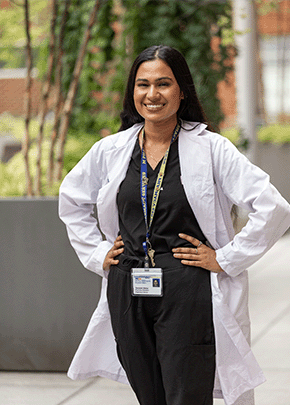

Carlette Norwood-Williams was sure she would retire after the COVID-19 pandemic. But deep down, she wasn’t ready to end her 35-year pharmacy career.
She found her next chapter as chief of pharmacy services for Tuba City Regional Health Care Corporation (TCRHCC), a tribally operated hospital serving the Navajo Nation in rural Arizona. The role represents more than a professional challenge — it honors a promise to her grandfather to “bless the Navajo” who saved his life.
Buoyed by her recent Certified Pharmacy Executive Leader (CPELSM) certification, Norwood-Williams is elevating pharmacists to improve patient care for this Native American community. ASHP News Center spoke with her to learn more.
Note: Responses have been edited for length and clarity.
Tell us about your origins as a pharmacist.
I was good in math and science growing up, and my dad dreamed that I would be an engineer. But I couldn’t see myself in a career doing something I hated. I went to my pastor for guidance, and his wife, a pharmacist, suggested I go into pharmacy. I got a summer job as a pharmacy technician supporting early AIDS therapy research, at a clerical level, which was very meaningful. So I changed my major and got into pharmacy school.
It is a privilege to practice pharmacy. Healthcare is like a relay: When you or a loved one doesn’t feel well, you pass the baton to your provider. When they write a prescription, they pass the baton to the pharmacist. We are the last leg in the relay, and if there’s a medicinal treatment for the ailment, pharmacy is who make the most lasting impact.
What is your connection to the Navajo Nation?
My grandfather became a sharpshooter in World War II, eager to prove his patriotism and fight for civil rights. His partner was a Navajo Code Talker, and they found common ground as minorities. One day, that Navajo gentleman shielded my grandfather from a Nazi grenade. For the rest of his life, my grandfather felt our family owed our bloodline to the Navajo. His dying wish was that I would use my education to “bless the Navajo.”
After the exhaustion of the COVID-19 pandemic, I considered leaving healthcare entirely. However, my husband insisted I wasn’t supposed to leave yet. I remembered this promise and realized he was right.
So, in 2023, I sought out pharmacy leadership roles on Indian reservations. It didn’t matter where because I was on a mission. Within days, I heard from Tuba City, Arizona, the home of the World War II Navajo code talkers.
What have your priorities been in this leadership role?
TCRHCC is unique because it operates as a private tribal health system, versus a service unit of the Indian Health Service. We are the only health system for 80 miles in any direction. Healthcare access is a clinical mandate for the Navajo Nation.
I’ve been focused on aligning our inpatient and outpatient pharmacy operations with the hospital’s strategic goals. My leadership ensures that pharmacy is not just a support service, but a primary contributor to fiscal and clinical vitality. If we are not visible, we are not viable.
Our team of 22 credentialed pharmacist-providers is currently integrated into primary. I seek to transition their roles to eventually support specialty care as well. For example, we’ve decentralized pharmacy services within the emergency department to improve medication safety and designed a new transitions-of-care clinic to reduce hospital readmissions.
I’ve also worked to improve workforce recruitment, retention, and resilience. We established a clinical rotation pipeline with pharmacy schools in Arizona and neighboring states, so we can attract students before graduation. I establish a foundation of trust with my staff and encourage opportunities for promotion. We’ve reduced our reliance on pharmacy contractors by 50%. Tuba City is proving that sustainable pharmacy staffing is achievable, even in what many would call the middle of nowhere.
Soon, I will transition to a schedule where I dedicate 20% of my workweek to patient-facing ambulatory care, which keeps me grounded in the patient experience and allows me to model pharmacy practice.
What have you learned from working in tribal healthcare?
Pharmacists need to expand our capability as provider extenders. In tribal healthcare, pharmacists can be credentialed as members of the medical staff through collaborative practice agreements. Private healthcare could learn from this model.
I’ve also learned we need to practice predictive intervention — not just in marginalized communities with high rates of chronic disease, but in all communities. With pharmacogenomics, just one blood test can determine whether a patient would do better on one type of medication versus another. We can look into the future of drug allergies, side effects, and other complications. We can support the provider in redirecting the medication regimen. And by being more proactive, we can improve how pharmacy is viewed at the C-suite level.
Why did you pursue ASHP’s CPEL certification?
CPEL has been on my bucket list since it was introduced. CPEL is the final piece of professional equipment I need to fulfill my grandfather’s directive and serve the Navajo Nation with the excellence they deserve. I want to ensure that the pharmacy enterprise I leave behind is even stronger, safer, and more viable than the one I found.
What do you want fellow health-system pharmacists to know about the CPEL capstone?
It was so humbling and rewarding to be included. I connected with accomplished peers from much larger, very well-known health systems. The CPEL facilitators (John Armistead and Tate Trujillo) are so in tune with real-world practice, too.
I could learn something from just about all of them — and they wanted to hear what I had to say, as well. Now we’re a brotherhood and sisterhood, and I feel that I could reach out to them anytime. The CPEL program validates your accomplishments and makes you want to do more. For pharmacists who want to move into executive leadership roles, CPEL will help you get there.
Earning your CPELSM credential validates your professional and leadership competencies and commitment to excellence in pharmacy leadership. Applications are now being accepted for the September (apply by July 15) or November capstones (apply by August 14).
Recent Articles

ASHP, Partners Defend Clinicians' Ability to Provide Evidence-Based Off-Label Care
July 23, 2026
ASHP Has New Policies on Standard of Care, Vaccine Access, Pharmacy Education, and More
July 21, 2026