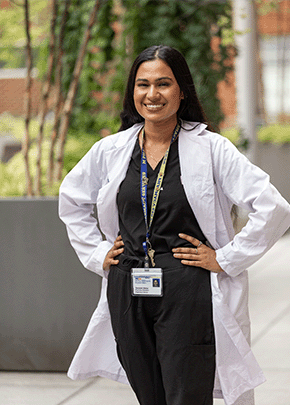


Angie Eustaquio has a track record of working on big initiatives — from launching the first clinical pharmacy services and a peer residency program at one hospital to now expanding comprehensive cancer care at another.
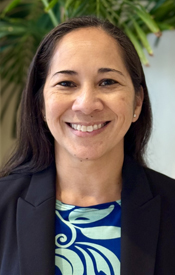
Still, when the hospital pharmacy director on Guam first scanned the roster of fellow participants in ASHP’s Certified Pharmacy Executive Leader (CPELSM) program, she admits feeling “a bolus dose of imposter syndrome.”
“The group is so accomplished and involved in big advancements in the profession, from specialty pharmacies to faculty positions in very prestigious pharmacy schools, overseeing large enterprises,” she recalled, adding that a 14-hour time difference makes networking and conferring with colleagues at other institutions difficult.
That’s to say nothing of the 22-hour journey to Bethesda, Maryland, where her cohort met last month for its capstone activities. Yet as Eustaquio participated in case scenario exercises, in-depth discussions, and informal conversations, she saw that she faced many of the same workforce, procurement, and drug shortages issues as her colleagues at larger health systems — albeit with a remote island twist.
The pharmacy leaders she met through CPEL, she said, will be “a reservoir I can tap into if I have an issue that’s difficult to navigate with my unique location.”
How the pandemic spurred change at her hospital
Eustaquio arrived at Guam Memorial Hospital in 2010 after graduating from what’s now known as the Daniel K. Inouye College of Pharmacy at the University of Hawaii. Eustaquio had grown up in Guam, an unincorporated U.S. territory with a population of 175,000 and only three hospitals: a public community hospital, a private hospital, and the U.S Naval Hospital.
As they did around the world, pharmacists in Guam distinguished themselves during the COVID-19 pandemic. The pharmacy team at Guam Memorial worked round-the-clock to standardize medication management, writing protocols for vaccines and outpatient medications.
Until that point, the team worked only in the hospital’s centralized pharmacy. But after the pandemic, the hospital agreed to establish a formal clinical pharmacy program, integrating the pharmacists into patient care.
“They saw what we could do,” said Eustaquio.
Along with her colleague, Alexa Adkins, Eustaquio researched ASHP standards and designed a program that started with training and recruitment. “We trained up the hospital pharmacists who did not have residency training or were not board certified,” she said. “To do this we implemented a peer residency program.”
A Unique Residency Program
Starting with six pharmacists, the program produced nearly a dozen full-time clinical pharmacists who staff every floor of the hospital, including the emergency department, and manage anti-coagulation services. Nearly all of the team grew up in Guam.
“The program was also meant to offer career advancement, growth, and opportunity for people to come home,” she said. “Like other rural or smaller communities, we lose our young bright professional workforce to larger communities with more opportunities.”
Geographic challenges
Planning is key to pharmacy’s success, but even more so on a remote island. Drug acquisition, for example, takes extra planning —“I don’t have FedEx overnight,” she said — so that medications don’t expire on the trip to the island.
Resources for professional growth and training are also limited. “On an island so far away from the rest of the country, it’s difficult to see how we fare with other hospitals, pharmacies, and health systems,” she said. “But (at Memorial) we were doing innovative things, building a service that was appreciated … so I felt a sense of pride.”
A New Opportunity at Guam Regional Medical City
The private hospital recruited Eustaquio to help expand and grow specialty pharmacy services for oncology. The hospital is adding much-needed cancer treatments, she said, because rates of certain cancers on Guam are higher than those in the rest of the country.
“We are treating patients who would otherwise have to move off the island to receive care,” she said.
Guam Regional is planning to open an outpatient pharmacy, with potential to expand the specialty pharmacy services to clinic patients. Her team is also eager to build up a clinical pharmacy program, she said.
Why CPEL is Valuable to Her New Work
Eustaquio said she hopes to take some of the skills she learned in her capstone activities, from addressing certain financial challenges to motivating the workforce, as she takes on the new cancer initiative.
And the cohort roster that initially intimidated her is now a community of colleagues she can turn to for advice; a key benefit of earing this leadership credential.
“To do things right,” she said, “it takes strong collaboration and learning from successful programs and people who led them.”
Recent Articles

ASHP, Partners Defend Clinicians' Ability to Provide Evidence-Based Off-Label Care
July 23, 2026
ASHP Has New Policies on Standard of Care, Vaccine Access, Pharmacy Education, and More
July 21, 2026