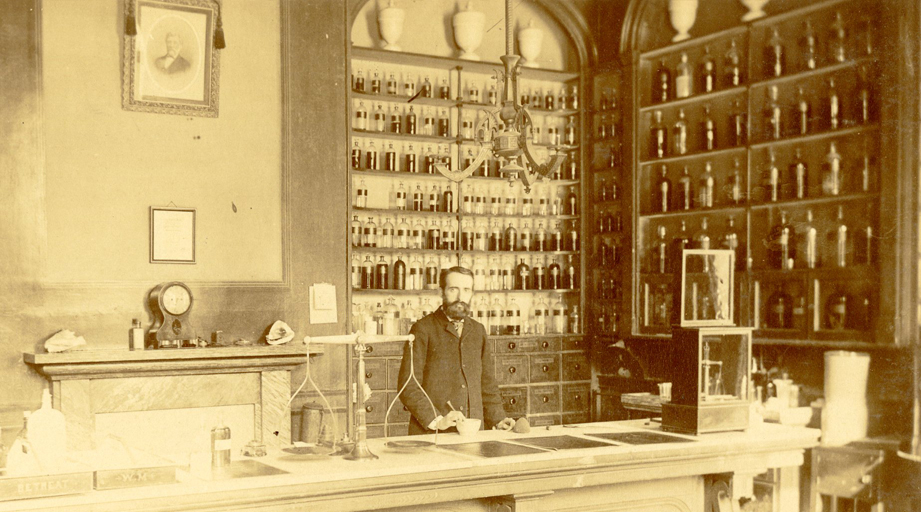


When Joseph F. Gallelli joined the staff at the National Institutes of Health (NIH) Clinical Center in 1961, the research hospital had been open for just 8 years, and the pharmacy team mostly kept to itself.
Gallelli, who would go on to serve as chief pharmacist at the Clinical Center from 1970 to 1995, said the pharmacy department originally operated out of space on the ground floor, preparing bulk medication stocks and sending them up to the nursing units through a dumbwaiter lift system. The nurses prepared their patients’ medication doses and used the dumbwaiters to return supplies to the pharmacy.
“Pharmacists were not allowed to go to the nursing units. They weren’t invited to be in there,” Gallelli said of the workplace expectations in those early days. Pharmacy staff also didn’t interact directly with physicians about their patients’ treatments. Instead, physicians communicated their medication orders to the nurses, who called down the orders to the pharmacy.
“The nurses were interpreting the doctors’ orders. And we didn’t know which medications were going to which patients and how they were being used,” Gallelli recalled. “So we were sort of blind in that system.”
In 1963, the pharmacy conducted a pilot project that brought pharmacists to 2 of the Clinical Center’s cancer wards to review medication orders and observe how nurses mixed and prepared IV doses. This was done with the intent of having the pharmacy department eventually assume full responsibility for IV dose preparation for specific wards.
After evaluating the nurses’ processes, the pharmacy began providing IV admixture services to the cancer wards for a 12-week trial period. The project was a success, and within a few months, the pharmacy had become responsible for IV admixture preparation throughout the 516-bed hospital.
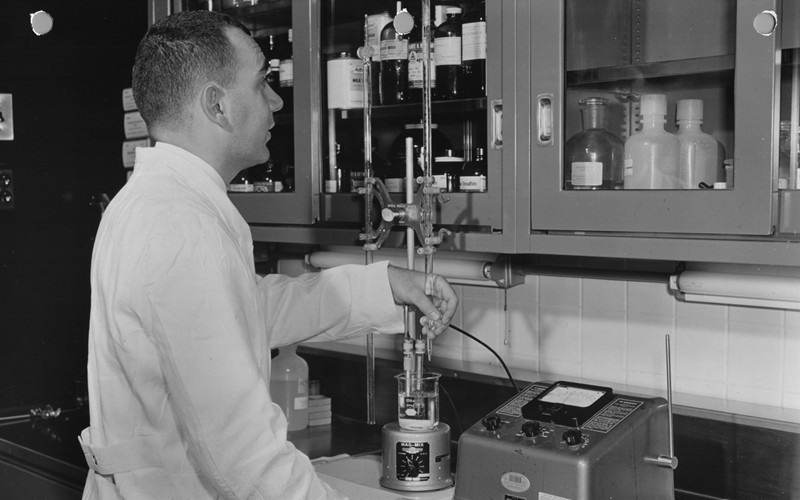
“That was the first exposure of pharmacists to a nursing unit,” Gallelli said. “And the pharmacists could see what medication was ordered and see if there were any incompatibilities or improper mixes of drugs and so forth. So that was a very big move.”
Gallelli said the pilot project helped set the stage for a workplace culture that welcomed pharmacists on the patient floors and ultimately created an expectation that clinical pharmacists were part of the care team.
“Eventually, the doctors would say, ‘That’s my pharmacist,’ Gallelli said. “Because he or she would be on that specific unit. So you’re going from a place where pharmacists were not allowed to be there to one that they were welcome.”
Gallelli’s NIH career in brief
The NIH Clinical Center was authorized in 1944 through the Public Health Service Act, and the research hospital opened its doors to patients in 1953. Milton Skolaut, who would serve as ASHP president in 1963–1964, was the Clinical Center’s first pharmacy chief and Gallelli’s first NIH boss.
During the 17 years that Skolaut led the department, he established the Clinical Center’s pharmacy, pharmaceutical development, central sterile supply, and radiopharmaceutical services. Skolaut hired Gallelli in 1961 to work in the Pharmaceutical Development Service, which produced investigational drugs for the hospital.
Before coming to NIH, Gallelli had earned a bachelor’s degree from the Long Island University Brooklyn College of Pharmacy in New York (1957). He attended Temple University in Philadelphia, PA, earning a master’s degree in industrial pharmacy in 1959 and a PhD in physical pharmacy and chemistry in 1962.
As part of his doctoral program, Gallelli spent time as a teaching fellow at Wyeth Laboratories, where he learned about drug product development. Gallelli was also looking for a way to fulfill his Vietnam-era military service obligation after graduation.
Thanks to his training as a pharmacist, Gallelli was eligible to complete his military service as a Commissioned Corps officer in the US Public Health Service (PHS). Gallelli said his dean at Temple University had a contact at the NIH Clinical Center who was looking for a PHS pharmacist with product development experience.
At the time, Gallelli said, all Clinical Center pharmacy staff were Commissioned Corps officers. Gallelli obtained his commission in 1961 and began 2 years of service as a staff pharmacist at the Clinical Center.
After he finished his military obligation, Gallelli was offered a special dispensation to remain at NIH as a civil service worker on inactive PHS status. He was named chief of the Clinical Center’s Pharmaceutical Development Service in 1962, and he retained that title when he was additionally appointed to lead the pharmacy department in 1970, succeeding Skolaut.
In 1995, Gallelli was named senior advisor for biotechnology product development. This position, which was overseen by Clinical Center Director John I. Gallin, involved incorporating concepts and standards that were created in the pharmacy department into the development of biological products used in transfusion medicine. Gallelli held the advisory position until his retirement from NIH in 2014.
Medication orders, unit dose dispensing, IV additive service
One of Gallelli’s earliest actions at the Clinical Center was to introduce what became known as duplicate doctors’ order sheets. This initiative, which was rolled out from about 1966 to 1970, involved placing a piece of carbonless copy paper under the medication order forms so the pharmacy had a physical record of each order. With that information available for the first time, the department had the data it needed to modernize the medication use process.
When Gallelli was promoted to pharmacy chief in 1970, he gained new authority to implement initiatives that further improved operational efficiency and patient care.
“That’s when we started to really move,” he said.
In 1975, the Clinical Center pharmacy became one of the first in the nation to install an advanced pharmacy computer system—the Technicon Medical Information System. This technology allowed medication orders and patient profiles to be transmitted to the pharmacy for review before medications were dispensed.
The computerized system also generated customized labels for drug containers and supported advanced pharmacy initiatives, including unit dose drug distribution.
“Once we got that order, then we wanted to not use floor stock—we wanted to use that individual order for that patient,” Gallelli explained. “So that’s why we started the unit dose system. We used a copy of the doctor’s prescription and made up a 24-hour supply of individually wrapped, sealed medications. And these were dispensed in small bins labeled with the patient’s name.”
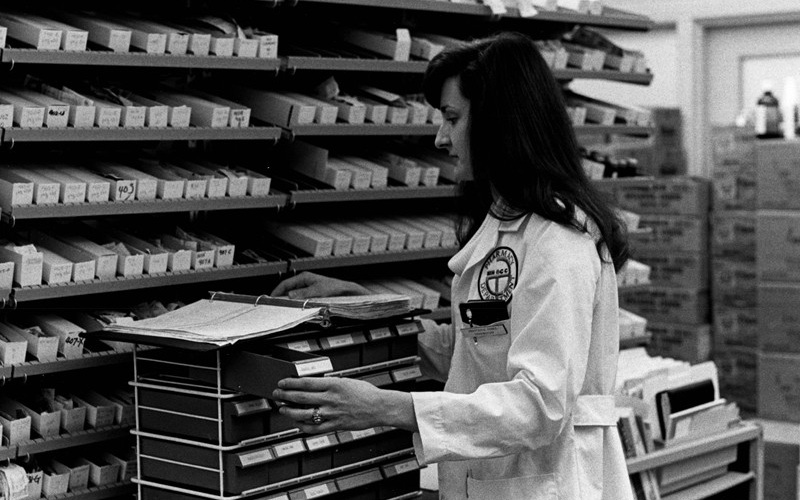
Previously, he said, the nurses kept pharmacy-dispensed tablets and capsules loose in medication trays on the patient floors.
Hospital pharmacies reportedly began exploring unit dose dispensing systems in the 1960s. By the mid-1970s, unit dose dispensing was widely recognized as safer and better for patient care than traditional hospital dispensing methods. The ASHP Board of Directors approved a statement on unit dose dispensing in 1975 to encourage hospitals to adopt the practice.
Gallelli said the Clinical Center introduced unit dose dispensing in 1974 and fully transitioned to a unit dose system in 1978. This helped the pharmacy track medications used in the many blinded research studies conducted at the Clinical Center.
“There was a need to do this,” Gallelli said. “It was a big help for the researchers to know somebody behind them was able to put the correct name to the drug.”
He said the unit dose dispensing process included pharmacist verification of each medication order, which increased patient safety and reduced medication discrepancies.
“The nurses loved it,” Gallelli added.
Sterile products
The Clinical Center’s IV admixture service introduced an innovation that was groundbreaking for pharmacy practice—the use of laminar flow hoods to manipulate medications in a sterile environment.
“That was a big thing, because the nurses had originally been preparing these IVs on the open counters,” Gallelli recalled.
Industrial investigations into laminar flow technology for cleanrooms and benchtop applications began in the early 1960s and quickly advanced. The US Department of Energy reports that by 1964, laminar flow devices were extensively used in industrial, medical, and military programs.
Gallelli had heard about the use of laminar flow hoods in the US space program, and he wanted to bring the technology to the pharmacy department. This was around 1963, when the devices weren’t yet commercially available. So Gallelli had one built.
“The Clinical Center had specialty areas where engineers made pieces of equipment that were needed by the doctors or the nurses,” Gallelli said. “So they went ahead and made us a laminar flow hood.”
Gallelli said the NIH laminar flow hood design, which was modified to include a high-efficiency particulate air filter, became a prototype for commercially produced units.
Further innovations in sterile IV product preparation were prompted by a national outbreak of nosocomial Enterobacter infections in 1970 and 1971. The outbreak was traced to contaminated IV fluid products made by Abbott Laboratories. Investigators attributed the problem to the company’s switch to a cap design that allowed microorganisms to move from the cap into the bottles as they were reopened and manipulated.
Gallelli referred to these IV fluid containers as screw-cap bottles.
“That caused a big ruckus, and we went ahead and converted from a screw-cap IV bottle to a sealed bottle, under pressure,” Gallelli said. “So that changed our whole IV system. We really got into making IVs using the proper IV bottles and things like that.”
Gallelli said that when the screw-cap bottles were used, it was common for hospitals to mix multiple IV medications in a single large bottle for administration without considering the potential for drug incompatibilities. The switch to sealed bottles supported the separate administration of IV medications, which was safer for patients.
But with the introduction of complex combination regimens for cancer chemotherapy, patients who required multiple medications at their commercially available strengths were at risk for fluid overload during infusion sessions. The pharmacy department solved this problem by preparing sterile IV admixtures in small volumes of fluid for Clinical Center patients.
By 1983, the pharmacy was producing 200,000 IV admixtures per year, up from 14,000 in 1963.
The growth in IV admixture services was made possible by another of Gallelli’s early initiatives—the establishment of a program to train pharmacy technicians in sterile product preparation.
“Years ago, there was no such thing as a pharmacy technician job,” Gallelli said. “So we had to train people to be technicians.”
The Clinical Center began training pharmacy technicians in 1971, more than a decade before ASHP released its first standard for the accreditation of technician training programs.
Drug development and HIV
The pharmacy department’s Pharmaceutical Development Service (PDS) formulated investigational drugs for clinical trials that took place at the Clinical Center. Gallelli said the section functioned as a manufacturer and had Food and Drug Administration (FDA) authorization to prepare these medications. The service had to meet the agency’s regulatory requirements, including the creation of an analytical data sheet for each drug.
Under Gallelli’s direction, PDS also formulated small peptides for investigational use. These drugs, which were not available elsewhere, contributed to advances in the diagnosis and treatment of endocrine disorders and other conditions.
During the early days of the AIDS pandemic, PDS worked closely with NIH researchers to develop investigational HIV drugs, said Anthony S. Fauci, who led the Laboratory of Immunoregulation at the National Institute of Allergy and Infectious Diseases at the time.
“Since the NIH, and specifically the NIH Clinical Center, is a research-based organization, the PDS worked hand-in-hand with the clinical investigators. That was essentially their full-time job,” recalled Fauci, who is now a distinguished university professor at the Georgetown University School of Medicine’s McCourt School of Public Policy. “This provided a unique situation rarely duplicated anywhere else.”
Fauci said his own lab was involved in multiple studies that required collaboration with the Clinical Center pharmacy.
“Our interactions were outstanding, and the collaborations were highly productive and collegial,” Fauci said. “Joe Gallelli was entirely committed to the success of our programs, and he and his staff were a pleasure to work with.”
Research and occupational safety
The product development group also conducted extensive drug compatibility and stability research to support safe and effective IV therapy at the Clinical Center and elsewhere. The results of several such studies were published in AJHP and other academic journals.
Gallelli, along with Lawrence A. Trissel, Carl R. Grimes, and their coworkers in product development, eventually compiled 13 years of stability and compatibility data to create the Parenteral Drug Information Guide, which ASHP published in 1974. Gallelli referred to the guide as the first edition of what would later become Trissel’s Handbook on Injectable Drugs (now published as ASHP Injectable Drug Information).
Most of Gallelli’s extensive publication record focuses on basic research, but he also wrote about emerging issues in occupational health.
In 1981, to address growing concerns about chemical exposure risks in pharmacy, Gallelli wrote an AJHP editorial that described published information, including his own team’s work at NIH, about the safe handling of antineoplastic drugs. The editorial offered basic guidance on prudent handling practices at a time when there was little published information on the subject.
In 1988, Gallelli coauthored an AJHP report, AIDS facts for pharmacists, that answered common questions about occupational HIV exposure risks and debunked misconceptions about how the virus is and is not transmitted.
“We published a lot of articles,” Gallelli said of his Clinical Center pharmacy team. “It was all a group effort.”
Clinical pharmacy services and an innovative residency program
One of Gallelli’s most meaningful undertakings was the 1979 launch of clinical pharmacy services at the research hospital.
This initiative eventually placed clinical pharmacists who specialized in oncology, infectious diseases, endocrinology, mental health, and other health concerns throughout the hospital to help guide medication use and to support clinical researchers and their patients.
Gallelli also created a clinically oriented drug information and pharmacotherapy consultation service that brought pharmacists and trainees to the bedside.
In 1974, when fewer than 70 ASHP-accredited pharmacy residency programs were operating, Gallelli established an institutional pharmacy practice residency at the Clinical Center. Within a decade, 34 clinical pharmacy residents had graduated from the program.
One of the program’s notable residents was 1976 graduate Charles E. Daniels, who is now chief pharmacy officer and associate dean at the University of California, San Diego.
Daniels, who received his bachelor’s degree in pharmacy from the University of Arizona, said one of his professors recommended the Clinical Center’s new residency program to him. Daniels found the program appealing, in part, because it looked like it would offer a unique and broadening pharmacy experience at a prestigious research hospital.
“It was about being there,” Daniels said. “I met people from all around the country—Mississippi, and Connecticut, and St. Louis, Missouri. And all of these were people that came from different pharmacy backgrounds.”
Daniels spent 2 years as a new practitioner at the Clinical Center, first as a resident then as a staff pharmacist. He said Gallelli had a vision that drove the adoption of modern pharmacy practices.
“We had created a central sterile compounding operation for the patients,” Daniels recalled. “Before then, the idea of preparing all sterile products in a clean environment was hit or miss in hospitals. And we did it for everything there. And I thought that was innovative.”
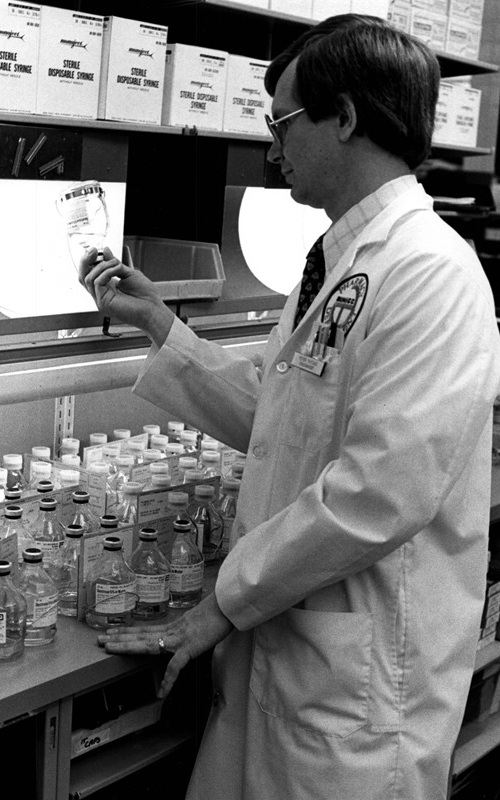
IV solutions prepared at the Clinical Center
pharmacy, 1983.
Daniels also considered the pharmacy department’s unit dose drug distribution system to be innovative for the time. But he was especially impressed by the work of PDS, which he likened to a small drug manufacturing operation.
“Investigators would come to the pharmacy with these out-there ideas about what chemical agents they wanted to treat patients with,” Daniels said. “It was all institutional review board-approved, but figuring out how to make that happen in a way that was scientifically replicable was an interesting challenge.”
Daniels said PDS had the equipment, staff, and training to produce validated pharmaceutical dosage forms that could be tested in clinical trials—including drugs that were later developed into commercial products.
“It gave me more of an understanding of what really happens in terms of the investigation of new agents for FDA approval of broad use,” Daniels said. “In fact, some drugs that are still in widespread practice now are ones that I remember managing and dispensing as a resident and then as a staff member in the mid-70s.”
Daniels left the Clinical Center for Minnesota in 1977 to earn a PhD in pharmacy administration. He worked in the state for 18 years, rising to the position of senior associate pharmacy director at the University of Minnesota health system.
In 1995, when Gallelli became the Clinical Center director’s senior adviser on biotechnology, Daniels returned to the hospital as chief pharmacist, a position he would hold for 9 years.
Despite some changes, such as the transfer of the radiopharmaceutical service to the nuclear medicine department and the sterile central supply to materials management, Daniels said the Clinical Center’s pharmacy enterprise operated mostly as he remembered from his previous time there.
But there were also important new enhancements, including sophisticated cleanroom areas and clinical research support services.
“Joe had secured funding and staff and implemented the pharmacokinetics research lab, which was a separate unit within the pharmacy department that did a lot of clinical pharmacokinetics associated with clinical trials,” Daniels said. He said the lab conducted early studies on how St. John’s wort and other natural remedies influenced the metabolism of recently approved HIV drugs.
Pharmacy practice had also advanced over the years, he said.
“Clinical pharmacy had grown substantially—and I mean substantially,” Daniels said. “The units all had their own clinical pharmacists, and those clinical pharmacists were very actively engaged directly with the institute’s clinical researchers.”
Clinical Center expansion
Today, the NIH Clinical Center consists of the original 14-story building, now known as the Warren Grant Magnuson Clinical Center, and the 242-bed Mark O. Hatfield Clinical Research Center, which opened to patients in 2005.
Construction of an ambulatory care research facility at the original Clinical Center began in 1977, and the new area opened in 1983. Gallelli said the pharmacy department evolved alongside the hospital by opening new satellite pharmacies to support outpatient care.
NIH broke ground on a new surgery, radiology, and laboratory medicine wing for the Clinical Center in 2023. The new area is projected to open in 2029.
Gallelli’s service and postretirement
Gallelli’s support of the profession includes serving as chair of the ASHP Committee on Research (1967–1969) and as a member of ASHP Foundation panels on education and grants. He also served on standards committees for the US Pharmacopeia, and he is a past president of the District of Columbia Society of Hospital Pharmacists (1966).

Gallelli said some of his fondest memories include traveling internationally and participating in International Pharmaceutical Federation meetings to talk about the Clinical Center’s pharmacy practice initiatives.
“We did so much that was innovative and unique, and I was fortunate to have opportunities to spread the word about our work,” Gallelli said.
Since retiring in 2014, Gallelli continues to travel, but he focuses mostly on his family and on the artistic expression of his faith.
“I paint icons with a Russian iconographer. And I have a class that I am responsible for, and we meet twice a month every month,” Gallelli said. “It’s a passion in my life.”
This news story appears in the June 15, 2026, issue of AJHP).
Recent Articles

ASHP, Partners Defend Clinicians' Ability to Provide Evidence-Based Off-Label Care
July 23, 2026
ASHP Has New Policies on Standard of Care, Vaccine Access, Pharmacy Education, and More
July 21, 2026