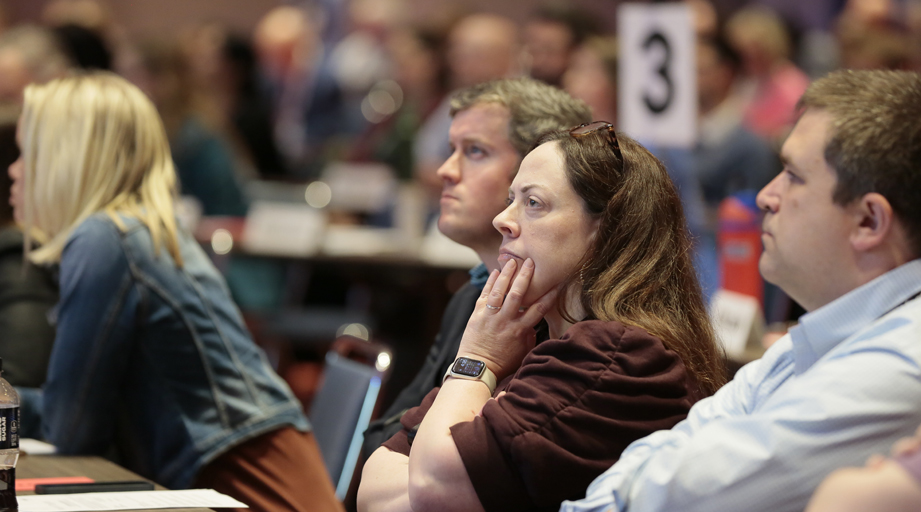


When it was looking to incorporate artificial intelligence (AI) in clinical trial research, the pharmacy team at University of California in San Francisco (UCSF) landed on a routine, but essential, documentation task.
Called Foghorn, the in-house AI tool finds key information from voluminous clinical trial documents to help build medication records. Handing this job to AI allows the team to spend time on more intensive clinical trial tasks, Lisa Janssen Carlson, formerly the investigational drug services manager at UCSF, said at a session of the 2025 Midyear Clinical Meeting & Exhibition.
Time is critical in clinical trials, with delays in setting up drug files leading to delays in patient enrollment. “Pharmacy does not want to be a barrier to getting this completed so it can go into the electronic health record,” said Carlson, who is now at Gilead.
Carlson argued that the tool’s efficiency can lead to safer outcomes, particularly in scenarios in which pharmacists would feel rushed completing the task manually.
“Trying to dig through at the last minute and manually create [a template] in the electronic record is not safer than this,” said Carlson.
Craig Michael, a UCSF data science pharmacist, took a deeper dive into how he and his team created Foghorn, which uses a large language model to run multiple retrieval-augmentation generation operations for question/answer tasks.
Those questions include dose and frequency, and Foghorn generates answers based on written protocols, pharmacy manuals, and drug company information. The tool is designed to comply with federal privacy requirements, retain zero data, and encrypt transmissions, said Michael.
Human oversight of the tool has been key, he said. “We do find extremely accurate responses,” said Michael. “If we’re asking what the dose should be, it’s going to find the relevant text that talks about the dose and pull that number out.”
But Foghorn has at times produced inaccurate results, leading Michael to have to figure out whether it was due to hallucinations or imprecise wording in the clinical documents.
For example, the written protocol in one trial gave the dose as a range on one page and as a specific number on another page. Foghorn didn’t have guidance on which number to choose.
“There’s nothing AI can do to fill that gap,” said Michael.
Carlson and Michael urged the audience to explore how they can develop their own AI tools for other routine pharmacy operations. But they emphasized AI tools should be used to streamline redundant processes — not replace the labor pool.
“We have hopefully demonstrated that this is not intended to replace a pharmacist or technician,” said Carlson. “The goal of this is to pull the information so I don’t miss something. I’d love to have this a way to make it safer for patients and then it opens me up to do other things.”
Listen to this ASHP Midyear Speaker Series podcast to hear Carlson and Michael speak more about their project.
Recent Articles

ASHP Has New Policies on Standard of Care, Vaccine Access, Pharmacy Education, and More
July 21, 2026
ASHP and Pharmacy Partners Call for Restoring Confidence in Vaccine Advisory Process Following ACIP Charter Revision
July 9, 2026